
Hatch chile peppers are New Mexico chiles grown in the Hatch Valley region, and they range from mild roasting peppers to extra-hot chiles used for salsa, sauces, marinades, and red chile pods.
The easiest way to choose the right Hatch chile is by heat level and cooking use. Big Jim and NuMex Joe E. Parker are best for roasting and stuffing, while Barker's Hot and Lumbre are better for hot salsa, chile sauce, and bold spice-forward dishes.

⬇️ Table of Contents
- Quick Hatch Chile Pepper Comparison
- What Makes a Hatch Chile Pepper Different?
- How To Choose the Right Hatch Chile
- Types of Hatch Chile Peppers
- Green Hatch Chiles vs Red Hatch Chiles
- Best Hatch Chiles for Roasting
- Best Hatch Chiles for Stuffing
- Best Hatch Chiles for Salsa and Sauces
- Hatch Chile Heat Tips
- Related Pepper Guides
Quick Hatch Chile Pepper Comparison
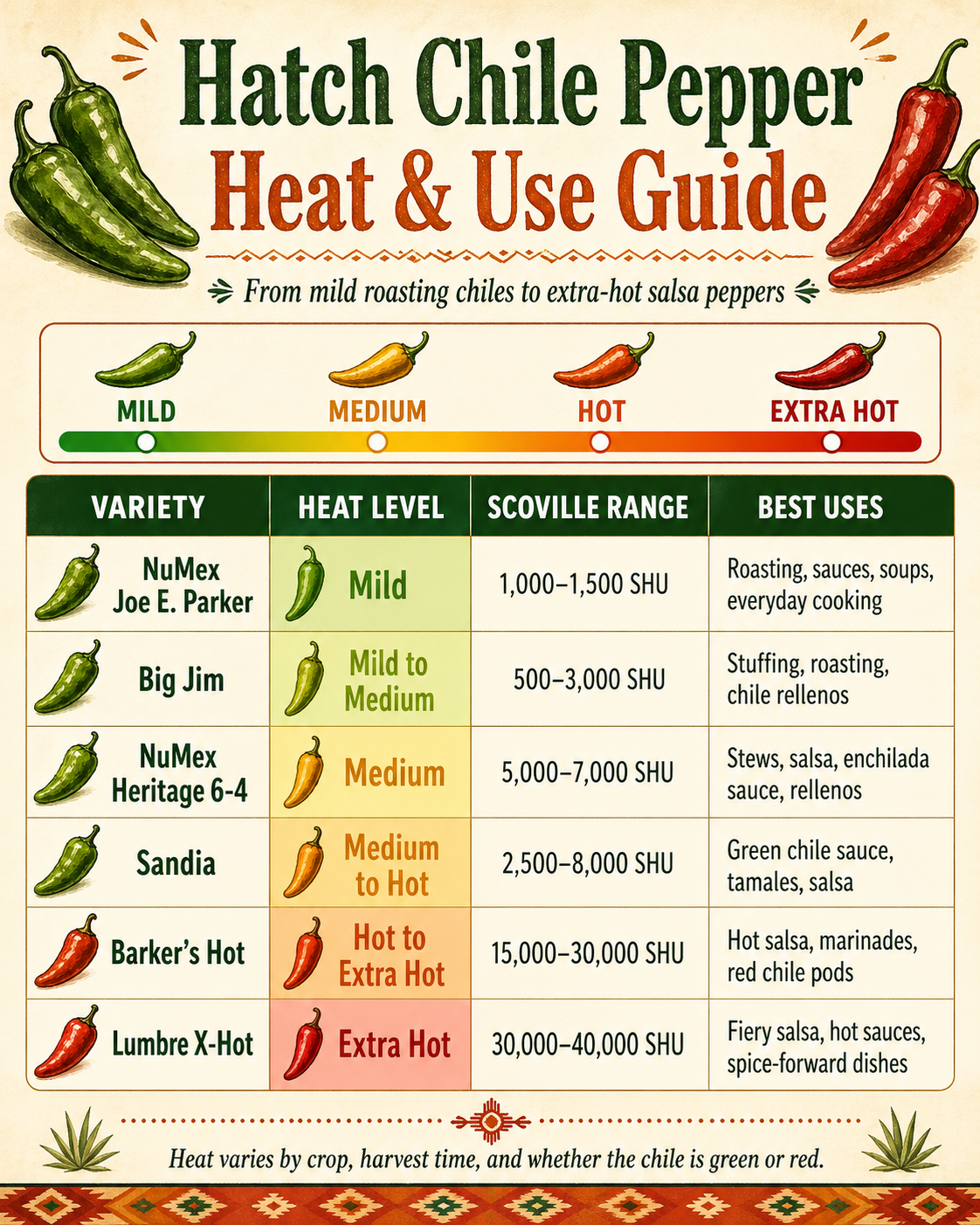
Hatch chiles are not one single pepper. They are a group of New Mexico chile varieties grown in and around Hatch Valley. Some are mild and meaty enough for roasting and stuffing, while others bring stronger heat for salsa, sauces, and dried red chile pods.
| Hatch Chile Variety | Heat Level | Scoville Range | Best Uses |
|---|---|---|---|
| NuMex Joe E. Parker | Mild | 1,000–1,500 SHU | Roasting, sauces, soups, everyday cooking |
| Big Jim | Mild to Medium | 500–3,000 SHU | Stuffing, roasting, chile rellenos |
| NuMex Heritage 6-4 | Medium | 5,000–7,000 SHU | Stews, salsa, enchilada sauce, rellenos |
| Sandia | Medium to Hot | 2,500–8,000 SHU | Green chile sauce, tamales, salsa |
| Barker’s Hot | Hot to Extra Hot | 15,000–30,000 SHU | Hot salsa, marinades, red chile pods |
| Lumbre X-Hot | Extra Hot | 30,000–40,000 SHU | Fiery salsa, hot sauces, spice-forward dishes |
Chef note: Hatch chile heat can vary by crop, harvest time, growing conditions, and whether the chile is used green or red. Use Scoville ranges as a helpful guide, not an exact promise.
What Makes a Hatch Chile Pepper Different?
A Hatch chile is a New Mexico chile grown in the Hatch Valley region of southern New Mexico. The name refers to where the chile is grown, not just one single pepper variety.
In the kitchen, Hatch chiles are loved for their thick flesh, earthy flavor, roasting quality, and wide heat range. They can be used fresh, fire-roasted, frozen, dried, or ground into chile powder.
For a broader pepper comparison, see our Scoville scale guide and complete types of peppers guide.
How To Choose the Right Hatch Chile
Choose the chile based on the dish. For stuffing and chile rellenos, use larger, milder peppers with thick walls. For green chile sauce and salsa, use medium to hot varieties. For hot sauce, marinades, and red chile pods, use hotter types like Barker's Hot or Lumbre.
| Cooking Goal | Best Hatch Chile Choice | Why It Works |
|---|---|---|
| Roasting whole | Big Jim, Joe E. Parker | Mild heat and good roasted chile flavor |
| Stuffed peppers | Big Jim, NuMex Heritage 6-4 | Larger size and thicker walls |
| Green chile sauce | Sandia, NuMex Heritage 6-4 | Balanced chile flavor and heat |
| Salsa | Sandia, Barker’s Hot, Lumbre | Stronger heat and bolder pepper flavor |
| Hot sauce | Lumbre, Barker’s Hot | Extra heat with strong chile character |
| Everyday cooking | Joe E. Parker, Big Jim | Mild enough for eggs, soups, sauces, and casseroles |
Types of Hatch Chile Peppers
Barker's Hot Hatch Chiles

Barker's Hot Hatch chiles are one of the hotter New Mexico chile varieties. They are often used when a recipe needs strong chile heat without moving into superhot pepper territory.
Heat level: Hot to extra hot, about 15,000 to 30,000 SHU.
Flavor: Bold, earthy, and chile-forward with enough heat to stand out in sauces and marinades.
Best uses: Hot salsa, green chile sauce, marinades, soups, stews, and dried red chile pods.
Chef note: Use Barker's Hot when you want clear heat, but start with a smaller amount if cooking for a mixed group.
Big Jim Hatch Chiles

Big Jim Hatch chiles are known for their large size and mild to medium heat. They can grow long and wide, which makes them one of the most useful Hatch chile varieties for stuffing.
Heat level: Mild to medium, commonly listed around 500 to 3,000 SHU.
Flavor: Mild, slightly sweet, earthy, and excellent after roasting.
Best uses: Roasting, chile rellenos, stuffed peppers, green chile cheeseburgers, salsas, and casseroles.
Chef note: Big Jim is the first Hatch chile to look for when you want size, roasting quality, and flavor without overwhelming heat.
Lumbre X-Hot Hatch Chiles

Lumbre Hatch chiles are among the hottest Hatch chile varieties. They are best for cooks who specifically want strong heat in salsa, sauce, hot sauce, and chile-forward recipes.
Heat level: Extra hot, about 30,000 to 40,000 SHU.
Flavor: Fiery, sharp, bold, and chile-forward.
Best uses: Fiery salsa, hot sauce, spicy green chile sauce, marinades, and recipes where the chile is meant to be the main heat source.
Chef note: Lumbre is not the best choice for mild chile rellenos. Use it when you want extra heat and add it carefully.
NuMex Heritage 6-4 Hatch Chiles

NuMex Heritage 6-4 Hatch chiles are medium-heat New Mexico chiles with a traditional roasted chile flavor. They work well when you want more heat than Big Jim but less intensity than Barker's Hot or Lumbre.
Heat level: Medium, about 5,000 to 7,000 SHU.
Flavor: Rich, earthy, and traditional, with enough heat to carry sauces and stews.
Best uses: Green chile stew, enchilada sauce, salsa, chile rellenos, and roasted chile strips.
Chef note: This is a strong middle-ground variety for cooked dishes that need real Hatch flavor without becoming too hot.
NuMex Joe E. Parker Hatch Chiles

NuMex Joe E. Parker chiles are mild New Mexico chiles that work well for everyday cooking. They are useful when you want roasted chile flavor without a strong burn.
Heat level: Mild, about 1,000 to 1,500 SHU.
Flavor: Mild, slightly sweet, balanced, and gently warm.
Best uses: Roasting, soups, stews, sauces, breakfast dishes, casseroles, and everyday green chile recipes.
Chef note: Joe E. Parker is a good family-friendly option when you want Hatch chile flavor without building the dish around heat.
Sandia Hatch Chiles

Sandia Hatch chiles sit in the medium to hot range and are known for bold New Mexico chile flavor. They are useful when you want a stronger pepper than Big Jim but do not need the extra-hot bite of Lumbre.
Heat level: Medium to hot, about 2,500 to 8,000 SHU.
Flavor: Earthy, robust, slightly sweet, and strong enough for sauces and salsas.
Best uses: Green chile sauce, salsa, tamales, stews, roasted chile, and Southwestern-style dishes.
Chef note: Sandia is a practical choice for green chile sauce because it brings both flavor and noticeable heat.
Green Hatch Chiles vs Red Hatch Chiles
Green Hatch chiles are harvested earlier, while red Hatch chiles are left on the plant longer to mature. Green chiles usually taste fresher and more vegetal. Red chiles develop a deeper, sweeter, and more concentrated chile flavor.
Green chiles are commonly roasted and used in sauces, salsas, soups, stews, breakfast dishes, and casseroles. Red chiles are often dried into pods or ground into powder for red chile sauce and seasoning blends.
Best Hatch Chiles for Roasting
Big Jim, NuMex Joe E. Parker, and NuMex Heritage 6-4 are some of the most useful Hatch chiles for roasting. They have enough flesh to blister well over flame or high heat, and their flavor becomes deeper after the skin chars and steams loose.
After roasting, place the chiles in a covered bowl or bag for several minutes so the skins loosen. Peel away the charred skin, remove the seeds if desired, and chop or slice the roasted chile for sauces, eggs, burgers, stews, and casseroles.
Best Hatch Chiles for Stuffing
Big Jim is the best choice for stuffing because of its larger size. NuMex Heritage 6-4 can also work when you want more heat. Look for straight, wide chiles with thick walls and enough room to hold cheese, meat, rice, or vegetable fillings.
For more pepper cooking ideas, see how to cook with peppers and hybrid and heirloom pepper varieties.
Best Hatch Chiles for Salsa and Sauces
Sandia, NuMex Heritage 6-4, Barker's Hot, and Lumbre are better choices for salsa and chile sauces when you want more heat. Sandia gives a balanced medium-hot result, Barker's Hot gives a stronger kick, and Lumbre is best for extra-hot salsa or hot sauce.
If you are making a large batch for guests, start with a milder chile and add hotter roasted chile in small amounts. It is much easier to increase heat than to fix a sauce that is too hot.
Hatch Chile Heat Tips
- Heat varies by crop. The same chile variety can taste hotter or milder depending on the season.
- Red and green taste different. Red chiles often have deeper sweetness, while green chiles taste brighter and fresher.
- Seeds are not the only heat source. Much of the heat is concentrated in the inner ribs and membrane.
- Roasting changes the flavor. Fire-roasting adds smoke, softens the flesh, and makes Hatch chiles taste richer.
- Choose by use, not just heat. Large mild chiles are better for stuffing, while hotter chiles are better for salsa and sauce.
Related Pepper Guides
- Types of Peppers
- Scoville Scale
- How To Cook With Peppers
- Hybrid and Heirloom Pepper Varieties
- Are Peppers Fruits?
- Padrón Peppers
Common Hatch chile varieties include Big Jim, NuMex Joe E. Parker, NuMex Heritage 6-4, Sandia, Barker's Hot, and Lumbre. They range from mild roasting chiles to extra-hot peppers used for salsa and hot sauce.
NuMex Joe E. Parker and Big Jim are two of the milder Hatch chile choices. They are good for roasting, stuffing, sauces, soups, and everyday cooking when you want chile flavor without strong heat.
Lumbre is one of the hottest Hatch chile varieties, often listed around 30,000 to 40,000 Scoville Heat Units. Barker's Hot is also a hot to extra-hot variety.
Big Jim is one of the best Hatch chile varieties for chile rellenos because it is large, mild to medium in heat, and easier to stuff than smaller chiles. NuMex Heritage 6-4 can also work when you want a little more heat.
No. Hatch chiles range from mild to extra hot depending on the variety. Big Jim and Joe E. Parker are milder, while Barker's Hot and Lumbre bring much stronger heat.


Leave a Reply